| MightyCall | Ringover | Aircall | |
|---|---|---|---|
| Phone numbers included | 3 | ||
| Minutes included | Unlimited* | Unlimited* with volume commitment | Unlimited* |
| SMS and MMS included | Unlimited* | ||
| Voicemail & transcription |  |
 |
|
| Voicemail drop Send pre-recorded voicemail messages straight to customers’ voicemail 
|
|
|
|
| Call forwarding | |
|
|
| Call recording | |
|
|
| Multi-level IVR | |
|
|
| Call routing | |
|
|
| Live call monitoring Call listening, barging, whispering, intercepting
|
|
|
|
| Call analytics | |
|
|
| Predictive dialer | Yes, 10-line per agent |  |
|
| Progressive dialer | |
|
|
| Preview dialer | |
|
|
| AI Answering machine detection MightyCall's AI AMD detects voicemail with over 97% accuracy and in under 3 seconds
|
|
|
|
| Local presence dialing Automatically match business numbers to your contacts’ area codes
|
|
|
|
| National Do Not Call List integration | |
|
|
| Roles & permissions system Admin, supervisor, and agent roles with custom permissions
|
Advanced | ||
| CRM integrations | |
|
|
| High-availability seamless redundancy infrastructure MightyCall runs multiple dedicated physical servers simultaneously, ensuring real-time synchronization for zero downtime and built-in redundancy
|
|
|
|

Feature set: Which provider is the best fit for your team?
To help you understand this all in depth, we’ll start by comparing Ringover and Aircall in terms of their key features.
Aircall
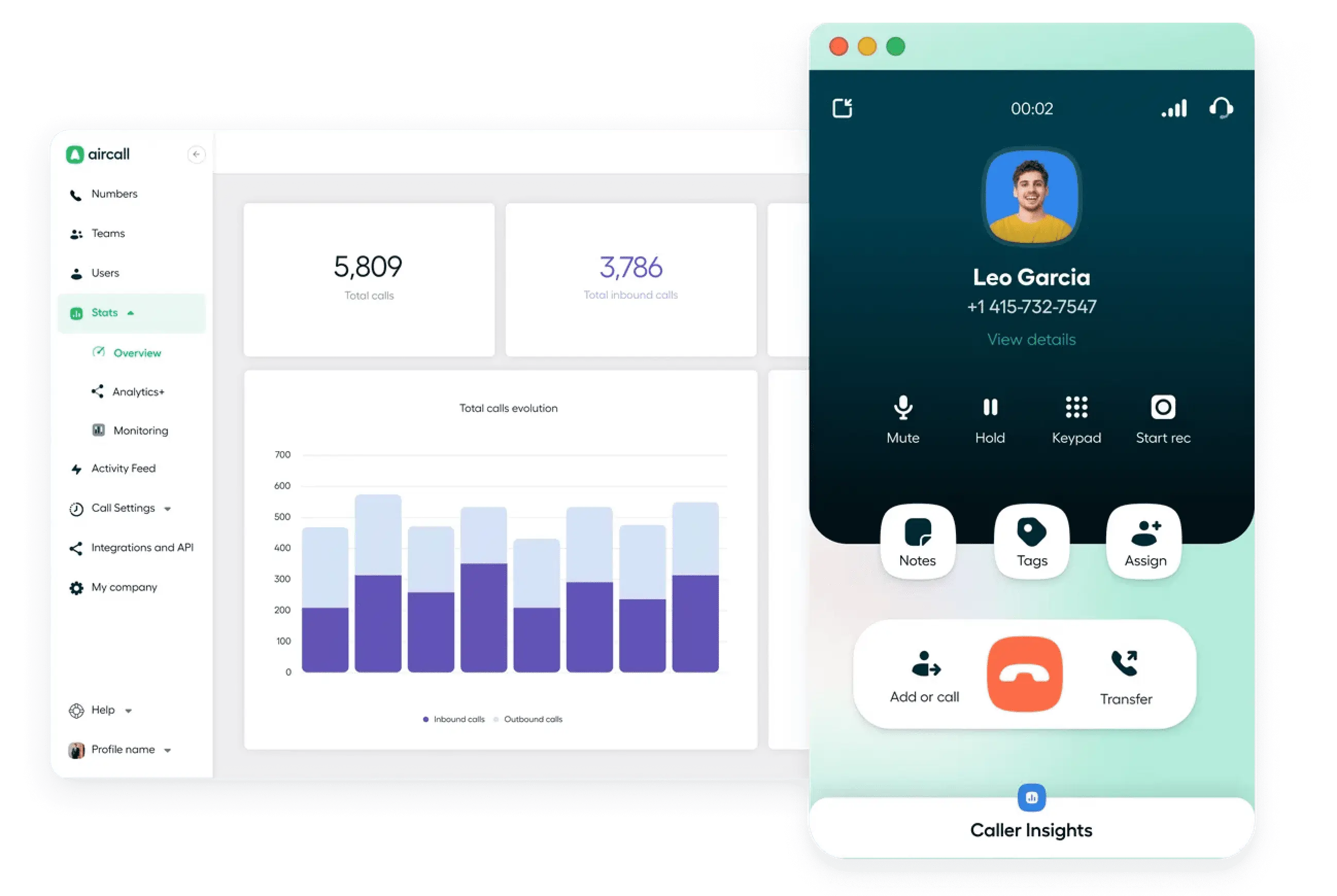
Aircall’s call center software is designed with simplicity and sales teams in mind. It offers a user-friendly interface, advanced call routing, and strong CRM integrations. Its power dialer streamlines outbound calls by automating number dialing.
On the analytics side, Aircall provides live call monitoring, team activity tracking, and performance dashboards, though reporting is more focused on high-level overviews than deep custom metrics. Other notable tools include call tagging, warm transfers, voicemail drop, and productivity-focused add-ons like call whispering and live coaching.
Aircall
Ringover
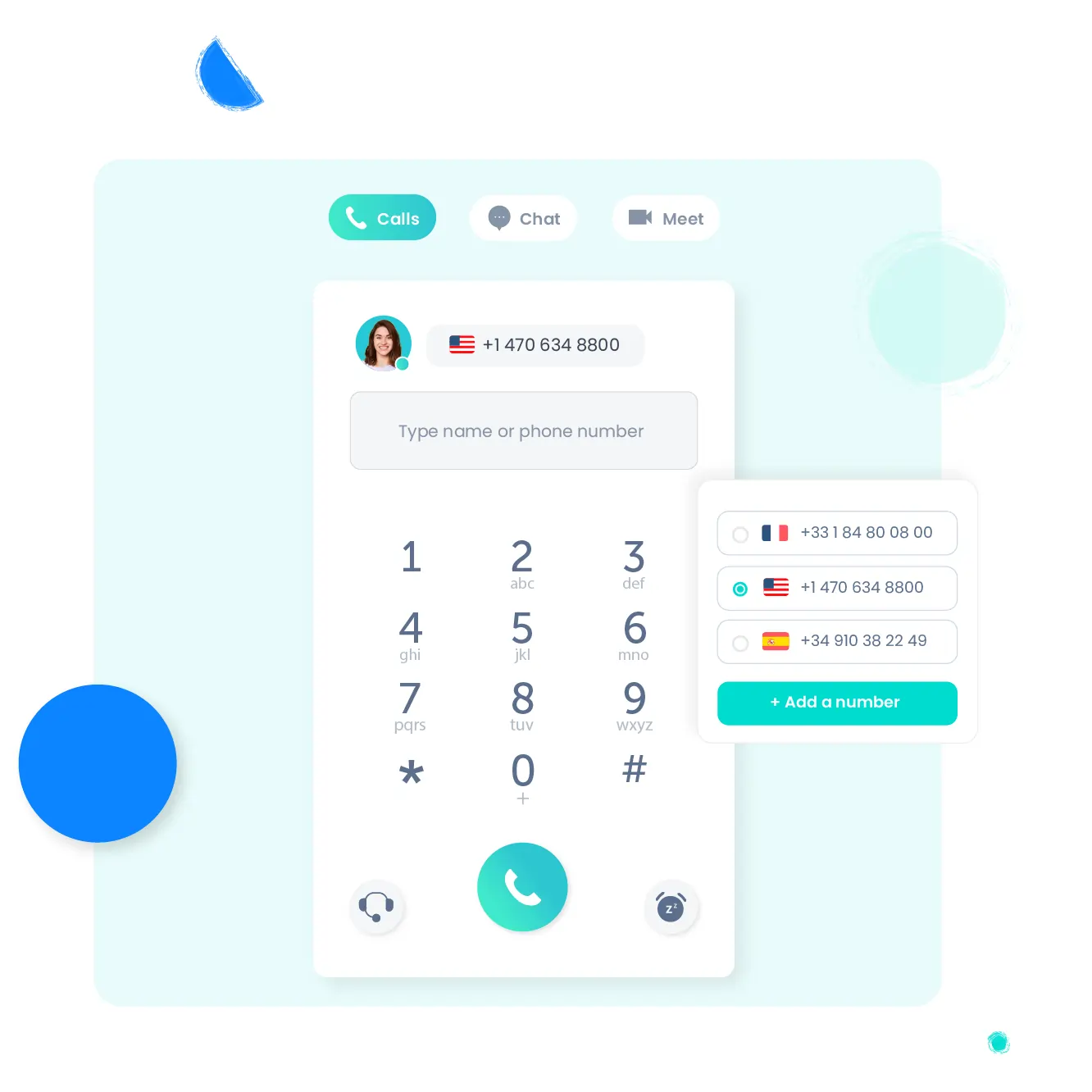
Unlike Aircall, Ringover places more emphasis on built-in analytics and team collaboration features. It offers detailed call statistics, customizable reports, and advanced filters for monitoring agent performance. The Smart Routing and IVR tools are highly flexible.
Ringover also includes integrated video calling, call recording with transcription, SMS/MMS support, and an internal messaging system for smoother team communication. It supports integrations with a wide range of CRMs and helpdesk tools, and allows local number purchase in 65+ countries.
Ringover
Winner: Ringover, as it is a more feature-rich platform with superior analytics and flexibility.
Pricing & plans: Does Aircall or Ringover best match your financial goals?
When it comes to pricing, the real question is what you can expect at each tier. Let’s do a comparison:
| Aircall | Ringover | |
|---|---|---|
| Lower-tier plans | $40 per user/month | $29 per user/month |
| Mid-tier plans | $70 per user/month | $54 per user/month |
| Highest-tier plans | Custom | Custom |
| Trial | Available | Available |
Aircall starts at $40 per user/month and includes ring groups, flexible call distribution, call recording, extensions, and productivity tools. AI-powered transcription is also available on lower-tier plans. However, advanced capabilities, such as smart routing, advanced analytics, and queue callback, are limited to higher-tier options. Features like call summaries and scoring are only offered through a separate AI product.
Ringover offers comparable core functionality, such as call recording, analytics, and call routing, starting at $29 per user/month. Upgrades focus on call management and integration depth, not basic functionality.
Winner: Ringover, for offering more value upfront without splitting features into separate products.
Security, service reliability, and compliance: Which service provider is safer?
Now, let’s look at the differences between the two services in how they handle infrastructure, certifications, and data protection practices.
Aircall
Aircall is SOC 2 Type II certified and fully GDPR-compliant. It protects data with AES-256 encryption at rest, TLS 1.2 in transit, 2FA, SAML-based SSO, and custom role permissions. Hosted on AWS, it maintains 99.95% uptime and leverages secure global voice carriers.
Aircall also anonymizes sensitive data before using AI features and follows a well-documented disaster recovery process.
Ringover
Ringover matches Aircall’s core protections but adds more regional transparency and certification depth. Security includes TLS 1.2–1.3, DTLS-SRTP for encrypted calls, HSM encryption, and HTTPS-only API access. Ringover is GDPR-compliant, appoints a dedicated DPO, and benefits from ISO 27001, PCI-DSS, and HDS certifications via its hosting partners. It’s fully redundant network spans 17 global data centers and boasts a 99.95% uptime rate.
Compared to Aircall, Ringover offers greater regional control and more specialized certifications.
Winner: Ringover
Integrations: Which platform supports more app connections?
Let’s explore Ringover vs Aircall in terms of the integration landscape.
Aircall
Aircall provides over 100 native integrations spanning CRMs (HubSpot, Salesforce, Pipedrive), support tools (Zendesk, Intercom), team chat apps (Slack, Microsoft Teams), e‑commerce, payments, workforce management, live chat, SMS, surveys, and quality assurance.
They’ve recently added an AI virtual assistant for automated customer service to expand beyond traditional integrations into conversational automation.
Ringover
Ringover offers strong CRM connectivity through its Marketplace, including Salesforce, HubSpot, Pipedrive, Zoho, Bullhorn, ActiveCampaign, Microsoft Dynamics, Sellsy, SugarCRM, and Vincere. It also integrates with collaboration and operational tools like Google Workspace, Gorgias, Help Scout, Slack, Jira, Monday.com, and Zapier.
Unlike Ringover, Aircall offers an incredibly broad integration ecosystem.
Winner: Aircall
Customer support and satisfaction: Which company cares the most?
Interestingly, there aren’t big differences between these platforms when it comes to support and satisfaction.
Aircall
Aircall holds a solid 4.3/5.0 rating on G2 based on over 1,300 user reviews. Its support channels include email, phone, and live chat, and assistance is offered in multiple languages. Customer support is responsive, but some users find certain updates disruptive and feel a few features lack polish.
Many users praise Aircall’s easy setup, friendly interface, and strong CRM integrations. It’s considered reliable for daily operations, especially for small and mid-sized teams. However, several reviewers mention occasional bugs, audio delays, and limited reporting flexibility.
I am in sales and use Aircall integrated into Salesforce. Aircall has made a huge impact in my productivity. I used to make calls on a cell phone. Now, just one click to call right from my laptop in the customer record is so much less of a hassle. I have the app on my phone too so if I’m on the road I can still make and receive calls. Love that everything is recorded in the specific customer’s files. It’s made it possible for me to sell $1.5+ million a year with a lot less stress.
Ringover
Ringover, compared to Aircall, has a higher G2 rating of 4.6/5.0, but this is only based on around 350 reviews. It offers support via phone, chat, and email, and users frequently mention the fast, knowledgeable assistance they receive.
Customers value Ringover’s intuitive interface, excellent call quality, and seamless CRM integrations. It’s especially favored by hybrid and remote teams thanks to its cross-device flexibility. Some mention higher costs compared to other providers, and minor issues with mobile features or support speed in rare cases.
We use Ringover daily in our sales and support workflows. It integrates well with our CRM and provides excellent call quality. The dashboard is user-friendly, and the analytics give us great visibility. Customer support has also been top notch. Highly recommend it for growing teams.
Winner: Tie
Does Ringover or Aircall check all the boxes?
Aircall and Ringover both offer helpful tools for business calling, but they’re suited to different needs.
Aircall is good for
Compared to Ringover, Aircall offers better tools for scaling teams. These include stronger CRM integrations, detailed analytics, and smoother onboarding. It’s especially useful for support or sales teams in North America that need reliable workflows, help with compliance, and collaboration features as they grow.
Ringover is good for
Ringover works well for European businesses with simpler calling needs. It covers the basics, such as call recording and monitoring, but doesn’t include more advanced features, like predictive dialing or in-depth agent analytics. It’s a decent option for teams that want a straightforward platform focused on local operations.
Not convinced? Meet MightyCall!
If Ringover and Aircall didn’t quite check every box, MightyCall might be the solution you’ve been looking for. Built for growing and mid-sized teams, the platform helps you stay productive and in control of your communications.
MightyCall Cloud Call Center
For a deeper look, don’t miss our head-to-head comparisons of MightyCall with Aircall or with Ringover.
Smarter dialing tools
MightyCall equips your team with three built-in dialer types—preview, power, and predictive—so agents can reach more leads with less manual work.
- Preview dialer lets agents review contact details before the call starts.
- Power dialer automatically calls the next number on the list as soon as an agent becomes available.
- 10-line-per-agent Predictive dialer uses algorithms to dial multiple numbers ahead of time and connects agents only when someone answers.
In addition, voicemail detection helps filter out unanswered calls by recognizing answering machines, so your team spends less time on dead ends.
MightyCall also integrates with the US National Do Not Call Registry to help your outreach stay compliant and targeted.
Clear roles, fewer roadblocks
User roles and permissions help keep responsibilities organized. Teams stay efficient, and everyone has access to exactly what they need.
Custom User Roles in MightyCall
Plans that fit your budget
Unlike platforms that reserve key features for expensive tiers, MightyCall includes full functionality at every plan level:
- Core ($25/user/month): Comes with advanced telephony features, user extensions, and role settings.
- Pro ($45/user/month): Brings in call monitoring, detailed reporting, and supervisor tools.
- Power ($65/user/month): Adds preview and progressive dialers, answering machine detection, and DNC list support.
- Enterprise (Custom pricing): Includes predictive dialer, SIP trunking, and custom integrations for high-volume teams.
There are no hidden fees, call volume commitments, or confusing upgrades.
See MightyCall
in action
–
schedule your personalized demo with our amazing team
schedule your personalized demo with our amazing team
Built-in reliability
MightyCall prioritizes stable, secure communication. Our high-availability infrastructure minimizes downtime and keeps your system running without interruption.
Real support
Support is available 24/7, with real people ready to help whenever needed. Whether it’s setup or troubleshooting, you get fast, reliable assistance.

Verified User in Construction
Small-Business (50 or fewer emp.)

We have really enjoyed the ability to give each individual their own extension, the call recording/transcription feature and the ability for managers to go back to listen whenever they want/need to do so for quality control purposes or for training new employees how to handle certain calls. Another HUGE plus is that their customer service team is AWESOME- they respond super quickly and are always extremely helpful!
Trusted by teams across industries
Thousands of businesses use the platform every day to keep communication clear and consistent. It’s easy to get started and even easier to stay on track, with MightyCall backing you every step of the way.

Play video
4x Call Volume and 10x Cheaper
“With the use of MightyCall, from the dialer they helped me create to the minutes they’ve been able to give me, I’ve been able to get my bill down to around $2,800 a month. From $32,000 to $2,800 dollars a month.”
Jason Elsen, owner of Black Creek Management
Prev
Next
01
01

Prev
Next
01
01
Reliable service to keep your
customers happy
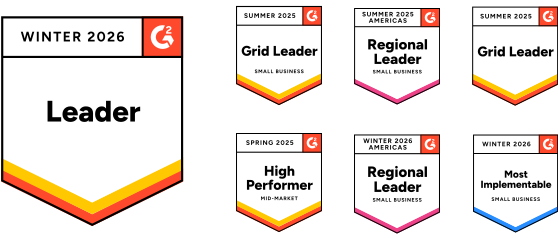
MightyCall is continuously recognized as a G2 Leader at 4.5 stars due to its reliable & intuitive nature, exceptional customer support, and ease of setup
MightyCall user ratings:


Integrate our virtual phone system
with your favorite apps








Got questions?
Our customer care team is standing
by and ready to help you!
by and ready to help you!







FAQ
Can I port my existing Aircall or Ringover number to MightyCall?
Yes! To get started, you’ll need to submit a porting request along with your account information, a recent invoice from your current provider, and a signed Letter of Authorization. The transfer usually takes less than a week. For full details, check out our number porting guide here.
What are the downsides of Ringover’s volume commitment?
Even if your team gets smaller or your needs change, you still have to pay for all the users you originally agreed to. This can lead to extra costs and less flexibility if your business changes during the contract.
Is onboarding faster with Aircall or Ringover?
Aircall generally offers a smoother and quicker onboarding experience, especially for teams using popular CRMs like HubSpot or Salesforce. In comparison, Ringover, while functional, takes longer to set up.
Built for high-volume calling,


MightyCall lets you run business communications your way: