
Key takeaways
- A power dialer automatically dials the next contact as soon as the previous call ends, helping teams move quickly through large outbound lists.
- A progressive dialer dials one contact at a time and waits until an agent is ready, which gives reps more control and prep time between calls.
- The main difference is pace and control: power dialers prioritize speed and volume, while progressive dialers prioritize timing, personalization, and lower risk of rushed calls.
- Power is best for cold calling, high-volume outreach, and campaigns where maximizing talk time matters most.
- Progressive is best for warm leads, follow-ups, and regulated or quality-sensitive calls where each conversation needs more attention.
Power dialer vs. progressive dialer: Key differences
| Factor | Power dialer | Progressive dialer |
|---|---|---|
| Best for | High-volume outbound campaigns, cold calling, rapid lead follow-up | Warm leads, personalized outreach, follow-ups, and compliance-sensitive workflows |
| Call ratio/pacing | Calls are placed continuously, with the next call triggered as soon as the previous one ends | Calls are placed one at a time, only when the agent is ready |
| Dialing method | More aggressive automation designed to keep agents in motion | Slower, agent-controlled dialing that leaves room for prep and note-taking |
| Agent control | Lower control over pacing, higher throughput | Higher control over pacing, better for structured conversations |
| Personalization | Less room for prep between calls, so personalization is more limited | Better for tailoring the conversation before each call |
| Compliance and risk | Efficient, but can be less forgiving if your process needs careful pacing | Lower risk of rushed or dropped calls because agents confirm readiness first |
| Productivity goal | Maximize calls per hour and scale outreach quickly | Balance efficiency with call quality and agent focus |
What is a power dialer?
A power dialer is automated dialing software that instantly calls the next contact in a list immediately after the prior call ends. It eliminates manual number entry, reduces idle time between calls, and lets agents make more calls per hour while maintaining full control over the call sequence.
How it works
- The agent uploads or selects a contact list in the system.
- The agent clicks “Start,” and the system auto-dials the first number.
- After the call ends (or fails), it immediately dials the next contact in the queue.
- If the number is busy, declined, or disconnected, it moves to the next one in the list.
- During the call, the agent works in the CRM, adds notes, and the system automatically logs the call result.
| Pros | Cons |
|---|---|
| Drastically increases calls per hour (agents can reach up to 3× more leads) | Less prep time before each call; harder for deep personalization |
| Saves 2+ minutes per call by eliminating manual copy/paste or dialing aircall | Higher speed can create a rushed rhythm and feel pressuring for agents |
| Guaranteed full list processing: the system won’t skip numbers like a human | Not ideal for regulated or quality-sensitive workflows that need pauses and control |
| Automatically logs outcomes to CRM (notes, tags, follow-ups) | For campaigns focused on warm leads and personalized conversations, a progressive dialer may be better |
| Perfect for cold calling, fast follow-up, and high-volume outbound | Mobile app functionality is often disabled; works mainly on desktop/SIP |
What is a progressive dialer?
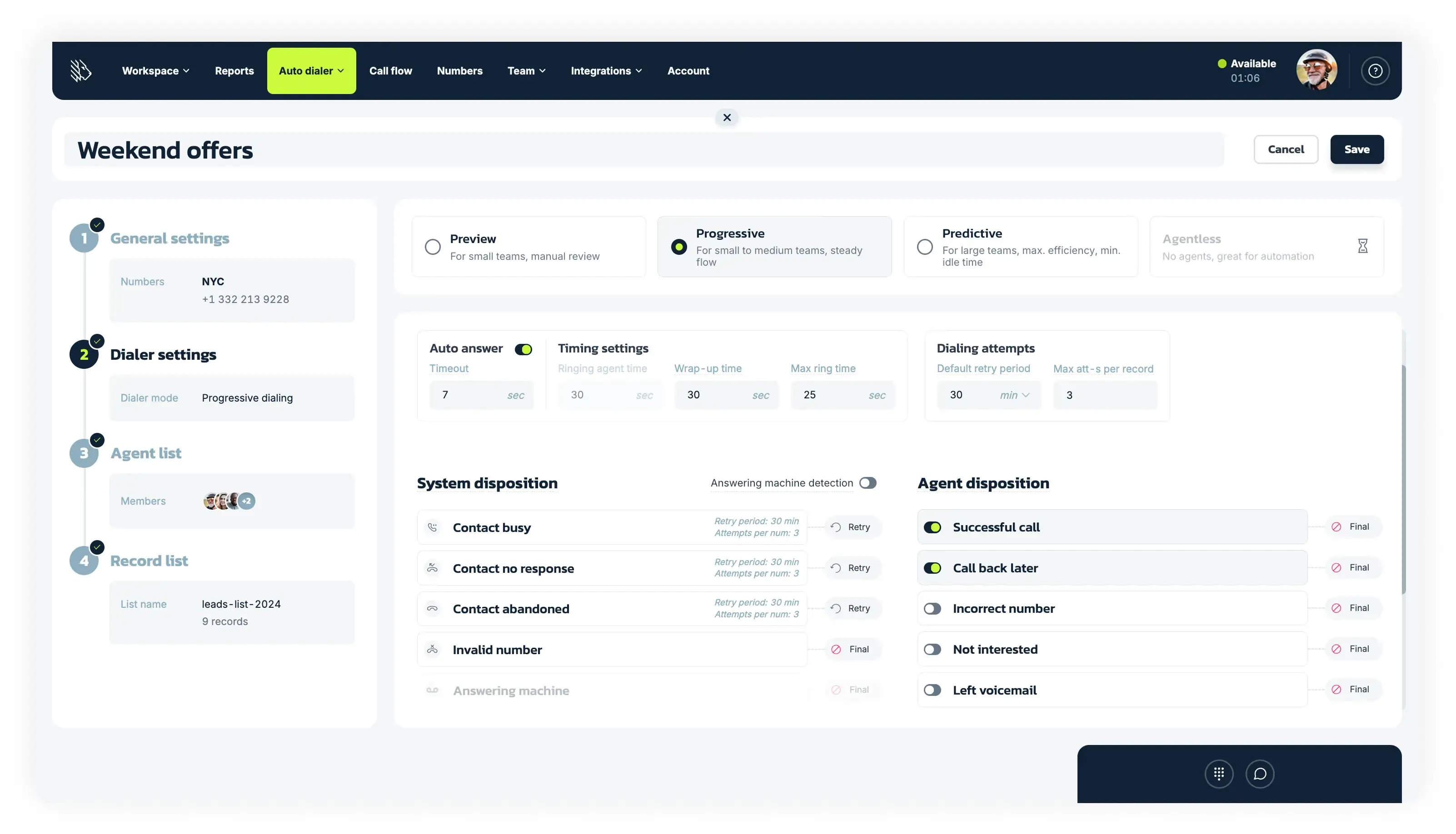
A progressive dialer is automated dialing software that calls one contact at a time and connects the call only when an agent is ready. It maintains a 1:1 agent-to-call ratio, eliminates dropped calls, and gives agents control over pacing while still automating number entry and reducing idle time.
How it works
- The agent selects or loads a contact list in the system.
- The dialer calls the first contact while reserving an available agent for that call.
- When the contact answers, the agent is connected immediately.
- After the call ends, the agent has wrap-up time for notes and complete follow-up tasks.
- The system then dials the next contact; if the first contact didn’t answer or was voicemail, it moves to the next number.
| Pros | Cons |
|---|---|
| Zero dropped calls: agent is always ready when the lead answers | Lower call volume per hour (75–80 calls/agent) compared to power dialer |
| 1:1 agent-to-call ratio guarantees immediate agent response for every lead | Slower pace: not ideal for high-volume cold calling or rapid list burning |
| Agents have prep time and wrap-up time between calls, improving conversation quality | Requires careful queue management; less efficient for very large teams with massive outbound lists |
| Better for warm leads, follow-ups, surveys, and regulated workflows where quality matters | Less aggressive automation means agents may feel less “pushed” but also produce fewer total calls |
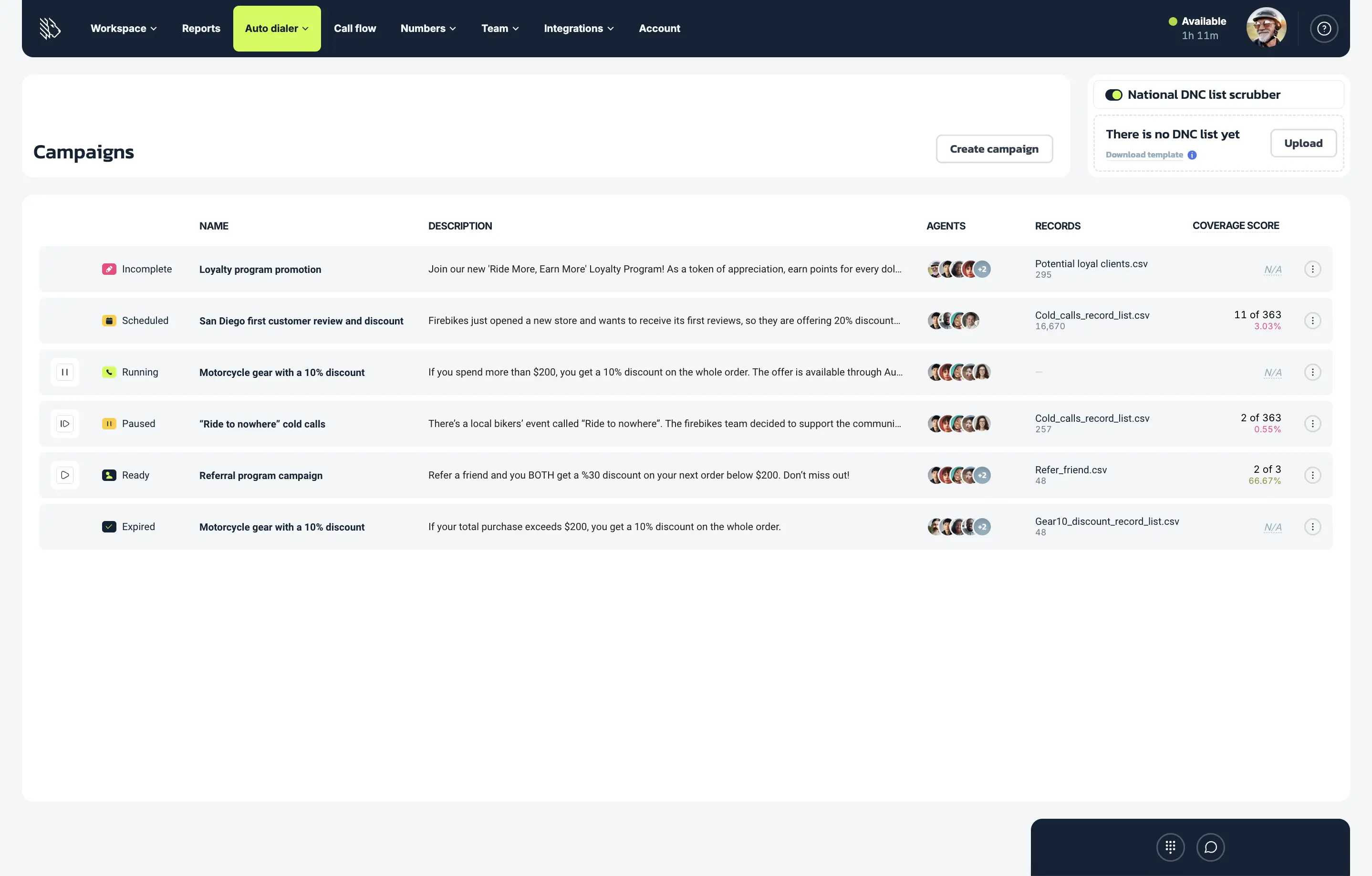
| Includes compliance features like national DNC scrubber to avoid FCC/FTC fines | Mobile app support may be limited compared to desktop/SIP-only power dialer modes |
Progressive vs. power dialer: Comparison overview
In this section, we will break down the core differences between progressive and power dialers across the dimensions that matter most for choosing the right tool for your call campaigns.
Best for
A progressive dialer is best for warm leads, personalized follow-ups, upsells, and customer service or survey calls where conversation quality is critical. It’s also ideal for regulated or compliance-sensitive workflows, such as collections and medical reminders, that require careful pacing.
A power dialer is best for cold calling, high-volume outbound campaigns, rapid lead follow-up, and any situation where maximizing call count is the main KPI. It works well for fast lead qualification and mass outreach where speed outweighs deep personalization.
Dialing method
A progressive dialer calls one contact at a time and connects the agent only when the lead answers, maintaining a 1:1 agent-to-call ratio. If the contact doesn’t answer or reaches voicemail, the system moves to the next number without connecting the agent.
A power dialer automatically dials the next contact immediately after the prior call ends, keeping agents in constant motion. The system continues to dial regardless of the call outcome, so agents may hear busy signals or voicemails if the list isn’t filtered.
Call ratio/pacing
A progressive dialer uses a 1-agent:1-call ratio, giving agents wrap-up time between calls for notes and prep. This typically results in ~75–80 calls per agent per hour, with a focus on quality.
A power dialer operates at an aggressive pace: the next call starts as soon as the previous one ends, minimizing idle time. It can generate 3× as many leads as manual or progressive dialing, which is volume-focused.
Personalization and agent control
A progressive dialer offers higher control: agents can review notes before each call and tailor the conversation. This makes it better for structured, relationship-building conversations like follow-ups and upsells.
A power dialer offers lower control: the fast pace limits prep time, making deep personalization harder. It’s better suited for transactional, speed-driven conversations, such as cold outreach and quick qualification.
Compliance and risk
A progressive dialer has a lower risk of rushed or dropped calls and includes features such as a DNC scrubber to avoid FCC/FTC fines. It’s safer for regulated industries such as healthcare, finance, and collections, where call quality matters.
A power dialer is efficient but can be less forgiving if your process requires careful pacing or compliance checks. It carries a higher risk of agent fatigue or forced rapid transitions if call volume becomes too aggressive.
Productivity goal
A progressive dialer balances efficiency, call quality, and agent focus, optimizing for conversation quality and conversion rate.
A power dialer maximizes calls per hour and scales outreach quickly, optimizing for volume and speed of lead contact.
When to use a power dialer
Use a power dialer when:
- You’re running cold calling campaigns and need to maximize call volume.
- You’re following up on new leads quickly after they’re captured (e.g., post-webinar, post-event outreach).
- You have a large outbound lead list and want to burn through it fast.
- Your team is small to medium-sized (up to 15 agents) and needs better efficiency.
- You’re running B2B campaigns where agents need more pre-call and after-work time than predictive dialing can offer.
- You’re running social or political surveys that require personalized conversations and automatic callback scheduling.
- Speed, volume, and agent efficiency are your top priorities.
- You want to eliminate idle time spent on busy tones, unanswered calls, or disconnected numbers.
- You’re working with medium or high-quality contact lists where contacts are likely to answer.
- Calls are longer (over 2 minutes), and you still want to maintain throughput.
When to use a progressive dialer
Use a progressive dialer when:
- You’re working with warm leads and need personalized follow-ups.
- Conversation quality and control matter more than raw call volume.
- You’re handling compliance-sensitive calls, such as collections, medical reminders, or regulated telemarketing.
- You want zero dropped calls and need agents to be ready when the lead answers.
- You’re running customer service follow-up calls or post-purchase outreach.
- Your team is small to mid-sized and can’t handle the high call volume of predictive dialing.
- You’re doing B2B outbound calling where answer rates are higher (over 80%) and hang-ups are fewer.
- You’re working with VIP clients, partners, or existing customers where preparation is critical.
- You need agents to have wrap-up time between calls to take notes and handle follow-up tasks.
- You want to avoid the aggressive pacing and agent fatigue that comes with power dialing.
How MightyCall supports outbound teams
MightyCall offers both power and progressive dialers designed for different outbound strategies. The power dialer automatically dials the next contact as soon as the prior call ends, minimizing idle time and maximizing call volume for cold outreach and rapid lead follow-up. The progressive dialer maintains a 1:1 agent-to-call ratio, connecting agents only when leads answer. This eliminates dropped calls and gives reps prep time between conversations.
Both modes include customizable settings such as ring time, wrap-up time, retry periods, and the maximum number of attempts per number. MightyCall also integrates a DNC list to ensure compliance with FCC/FTC regulations and protect teams from fines. Whether you’re running high-volume outbound or quality-focused follow-ups, MightyCall adapts to your campaign goals while keeping agents productive and compliant. Start your free trial with MightyCall today and choose the dialer that fits your team.
Power dialer or progressive dialer: How to choose?
Follow these steps to pick the right dialer for your call campaigns:
1. Analyze your campaign goals
Determine whether speed and volume (power dialer) or quality and personalization (progressive dialer) are your primary KPIs.
2. Evaluate your lead type
Cold leads and mass outreach work best with power dialing; warm leads, follow-ups, and VIP clients need progressive dialing.
3. Check compliance requirements
If you’re in healthcare, finance, or collections, progressive dialing with DNC scrubbing reduces regulatory risk.
4. Assess your team size
Small to mid-sized teams (up to 15 agents) often benefit from progressive dialing; larger teams with high-volume goals may prefer power dialing.
5. Review call duration and quality needs
Longer calls (over 2 minutes) and relationship-building conversations favor progressive dialing; quick qualification calls favor power dialing.
6. Consider agent comfort and pacing
If your agents need prep and wrap-up time between calls, progressive dialing helps prevent fatigue.
7. Test both modes
Run a pilot with each dialer type and measure call volume, conversion rate, and agent satisfaction before committing.
Which is best for your business?
The right dialer depends on your campaign goals. Choose a power dialer if you need speed, volume, and maximum call throughput for cold outreach and rapid lead follow-up. Choose a progressive dialer if you prioritize conversation quality, compliance, and agent control for warm leads, follow-ups, and regulated workflows.
MightyCall offers both dialer types with customizable settings and compliance features, so you can switch between modes as your campaigns evolve.