

Many executives face intense pressure to modernize the customer experience while reducing costs, often tempted by the “let’s launch this fast” approach. However, bypassing fundamental elements leads to declining quality, compliance violations, and agent burnout.
In this article, we will take you on a magic carpet ride to the blueprint for building a virtual call center from home, the smart way. You’ll gain clarity on whether to own or outsource it, along with practical steps and KPIs to keep performance on track. Let’s take that ride, shall we?
Key takeaways
Set up a virtual call center solution with a clear strategy that keeps speed, scalability, and compliance in balance.
- Operating model: Decide whether to build in-house for greater control and customization or partner with a BPO for quicker setup and specialized expertise.
- Scope evolution: Start with voice support, then gradually expand to a full omnichannel contact center that manages email, chat, and social interactions.
- Tech stack essentials: Focus on reliable VoIP, IVR, and CRM integrations to ensure seamless operations and efficient data flow.
- Agent readiness: Recruit remote agents and provide training on soft skills, tools, and scripts to reduce ramp-up time and maintain consistency.
- QA and KPIs: Set up call monitoring, regular coaching sessions, and track key call center metrics like AHT, FCR, and CSAT for ongoing optimization.
- Compliance and continuity: Build data privacy (GDPR/CCPA), call recording policies, and backup systems into your processes from the start.
- Timeline: Plan to launch the MVP within 4-6 weeks and have full operations within three months, scaling as you grow.
What a virtual call center is and how it operates today
A virtual call center is a cloud-based setup in which agents work remotely from home or any other location. Unlike traditional call centers that rely on a physical office, these centers use VoIP technology and online call center platforms to connect teams, manage calls, and provide customer support across locations.
Today’s virtual contact center businesses run on centralized cloud platforms that handle call routing, queues, call recording, performance monitoring, and analytics. They also integrate with CRMs and business tools to keep data consistent across channels. With legacy phone systems saying “bye-bye-bye” to us in many regions, cloud adoption has become the standard for scalability and resilience.
What you need, at least:
- A stable internet connection and a VoIP setup
- Cloud-based call center software
- Headsets and communication tools
- CRM or helpdesk integration
Why starting a virtual call center matters
Starting a call center operation may deliver strong business outcomes. Let’s say it can lead to higher CSAT and first call resolution rates due to better agent satisfaction, rapid coverage scaling during peaks, and access to global hiring talent.
The smart approach starts with key decisions and an operating model, followed by processes and tech selection. Companies save a substantial amount per remote employee each year by reducing office costs and utility expenses, making this model highly efficient.
- Cost savings: According to Global Workspace Analytics, companies save up to $11,000 per remote agent/year.
- Improved CSAT/FCR: Remote work boosts agent performance and leads to better resolutions.
- Scaling speed: Adjust staffing instantly for demand spikes without fixed infrastructure.
- Hiring reach: Tap global talent pools at lower costs with a fully remote approach.
- Continuity: Operations remain unaffected by location disruptions.
Virtual call center vs contact center: Which should you set up first
Compared to contact centers, virtual call centers focus primarily on voice calls. Meanwhile, contact centers expand to omnichannel support, including chat, email, and social media.
Start with a virtual call center if voice demand dominates your customer interactions and your processes are still in the early stages. This keeps setup simple and lets you refine operations first. Opt for a contact center upfront if customers already expect multi-channel engagement and you have ticketing or CRM workflows in place to handle it seamlessly.
When a call-only center is enough
A call center works well when customer needs are straightforward and you prioritize speed over complexity. It’s ideal for scenarios like simple support queries, low demand for non-voice channels, early-stage teams building core skills, or tight budgets that limit tech investments.
- Fewer tools needed: Stick to VoIP and basic routing, no need for multi-channel platforms yet.
- Faster agent onboarding: Train on voice scripts and calls alone.
- Easier QA focus: Monitor and coach single-channel interactions.
When a full contact center becomes a business opportunity
A full contact center shines like a bright star when omnichannel support drives revenue and CX gains. That includes handling high-ticket volumes or serving audiences who prefer chatting over phone calls (introverts, come together).
- Broad resolution context: Agents can see the full conversation history across channels for faster, more accurate fixes.
- Fewer repeat contacts: Omnichannel continuity reduces escalations and boosts FCR.
- Smarter analytics: Unified data reveals trends and optimizes every touchpoint.
How to start a virtual call center: Key steps for full rollout
Setting up a remote call center goes beyond picking software. It’s a full rollout that covers strategy, operations, and continuous improvement. Follow these steps to build a scalable, high-performing remote team from the ground up.
- Choose the right operating model
- Define your scope and services
- Select your tech stack
- Set up your infrastructure
- Hire and onboard remote agents
- Build your training program
- Launch the virtual model of your call center
- Optimize with metrics
- Design with compliance in mind
- Scale while keeping quality
1. Choose the right operating model for your business
Choosing the right operating model sets the foundation for your virtual call center’s efficiency, cost structure, and growth potential. Decide between in-house control or BPO outsourcing, then define your focus—inbound, outbound, or hybrid—to align operations with your goals from day one.
Create your own virtual call center or work with a BPO
Decide between establishing a virtual call center on your own or partnering with a BPO based on your needs, scaling speed, and expertise gaps. In-house offers full customization and ownership, while BPOs deliver rapid implementation and specialized support. Both options use global remote hiring for flexibility.
| Build Your Own | Use a BPO |
|---|---|
|
|
Inbound, outbound, or hybrid call center models
Inbound, outbound calls, or hybrid? Pick the model that matches your goals. Each handles customer interactions differently, but all work seamlessly in virtual setups.
- Inbound: Customers call you (e.g., for support tickets or billing help). Ideal for building retention and trust through responsive service.
- Outbound: You call customers (e.g., sales outreach or surveys). This option focuses on lead generation and proactive revenue growth.
- Hybrid: Blends both to deliver full CX and revenue. Routes calls dynamically but demands strong routing, QA, and staffing to avoid chaos.
Warning: Hybrid adds operational complexity; only pursue it once you have solid routing rules, QA processes, and agent discipline in place.
Match tools to goals and volume
Match your tools to your call center’s goals and volume
- Low volume (inbound, outbound, or blended): Keep it simple with reliable VoIP, a basic IVR, and manual routing. Agents onboard fast, costs stay low, and nothing gets overly complicated.
- High-volume outbound: Go all-in on automation. Power or predictive dialers, AMD to avoid voicemails, and local presence for higher pickup rates.
- High-volume inbound: Handle the rush with, for example, automatic call distribution or AI voice agents.
- Blended (hybrid): Blending software switches agents between inbound/outbound on real-time demand. No idle time with pure efficiency.
2. Plan your virtual call center before buying software
Don’t jump into call center software too soon; planning first helps you avoid mismatched tools and a bumpy customer experience. It helps everything align smoothly.
Start by nailing down your goals (like call volume or CSAT targets), mapping out your operating plan (staffing and workflows), and setting a solid budget. That way, tech choices fit perfectly.
Define business goals and customer experience outcomes
First, clearly define your business goals and what a great customer experience looks like, so you can set up a virtual call center. These set the direction for staffing, tech, and everything else.
- Cut cost per call: Keep average handle time (AHT) under 5 minutes.
- Extend coverage hours: Achieve service levels such as 80% of calls answered within 20 seconds.
- Boost CSAT scores: Aim for 85%+ in post-call surveys.
- Improve FCR: Target 75%+ resolutions on first contact.
Create an operating plan for how the call center will run
Your operating plan should outline how your advanced call center operates every day: when you’re open, which regions and time zones you cover, which channels you support, etc.
It also needs to clarify your staff’s work-life balance, such as agent schedules, coverage targets, how you handle spikes in volume, and how managers supervise remotely through live monitoring, coaching, and call recordings.
Set a realistic budget to start and operate a call center
Launching a virtual call center is relatively inexpensive up front, but costs can spiral if you don’t invest enough in QA, training, or proper staffing. Remote models can save a lot of money by reducing office space, utilities, and hardware, but you still need a clear view of setup vs. ongoing expenses.
| One-time setup costs | Ongoing operating costs |
|---|---|
| Laptops, headsets, and initial licenses | Per-user software subscriptions (VoIP, CRM, helpdesk) |
| Initial training and onboarding programs | Salaries, benefits, and QA/coaching time |
| Process design and documentation | Telecom minutes, internet, and cloud storage |
| Security/compliance setup | Continuous training and knowledge base maintenance |
3. Build the virtual call center technology stack
Pick the right tech stack for your virtual call center by matching the platform to your model (inbound, outbound, or hybrid) and your channels, whether it’s voice-only or full omnichannel. This keeps everything aligned without overspending or missing key features.
Core virtual call center software requirements
The right virtual call center software needs to nail the essentials first, such as reliable VoIP for clear calls, IVR menus to guide callers, smart queues and routing, call recording for training, live monitoring, and coaching tools.
Additionally, it’s nice to have solid reporting and analytics, role-based access, easy CRM integrations, rock-solid uptime, and straightforward admin controls.
Must-haves at a glance:
- VoIP for crisp remote calls
- IVR for self-service options
- Queues and call routing
- Call recording
- Live call monitoring
- Dashboards and reports
- CRM and helpdesk integrations
- 99.99% uptime guarantee
- Simple role permissions
Hold off on fancy extras like AI until your core workflows are steady. MightyCall fits perfectly here; it packs all this into one easy platform with unlimited calling, ideal for virtual teams. Give it a free trial to test the setup yourself.
Integrate CRM, ticketing, and knowledge systems
Integrating your CRM, ticketing, and knowledge base systems with your call center platform gives agents instant context, boosting first-contact resolution and reducing the frustration of repeated explanations.
Sync the following key elements:
- Customer profiles and interaction history
- Open tickets and status updates
- Call dispositions and tags
- Notes, summaries, and next steps
Use AI to support agents and improve call quality
AI makes virtual call centers smarter by taking on repetitive tasks and spotting patterns, such as sentiment shifts, suggesting coaching tips, auto-scoring QA, and recommending better call routing. It speeds things up and highlights where agents need help.
Humans still handle the tough stuff: empathy, tricky negotiations, complex issues, and one-off exceptions that require real judgment.
4. Set up the remote agent environment for consistency
To keep remote agents consistent and professional, set clear standards for their work-from-home setup. This ensures reliable call quality, security, and a smooth customer experience; no one wants muffled audio or dropped calls from spotty connections.
Aim for dedicated quiet spaces, noise-canceling headsets, fast internet, and basic security like VPNs to avoid uneven performance across the team.
Equipment and connectivity requirements for work-from-home agents
Set clear equipment and connectivity standards for work-from-home agents to ensure reliable, professional calls every time.
Minimum requirements:
- Modern computer (4+ GB RAM, webcam for video check-ins)
- Noise-canceling headset with mic
- Wired Ethernet (preferred) or 50 Mbps+ internet
- Quiet, dedicated workspace
- Backup mobile hotspot for critical roles
Security and data protection
Security isn’t an add-on; it’s imperative to daily virtual operations in virtual call centers, protecting customer data and preventing breaches.
Set core controls like role-based access permissions, MFA or SSO logins, secure/approved devices only, and full monitoring with audit logs. For recordings, enforce clear governance: obtain consent upfront, limit access, and store them securely to meet privacy laws such as GDPR.
5. Create workflows that keep the call center operating smoothly
Proper workflows are the backbone that turns your virtual call center strategy into smooth daily execution. They safeguard quality and consistency as you add more agents and volume.
Make key components, such as call routing rules, agent scripts and prompts, after-call work (notes, dispositions), and QA review your standard processes to keep everyone aligned.
Call routing and call flow design
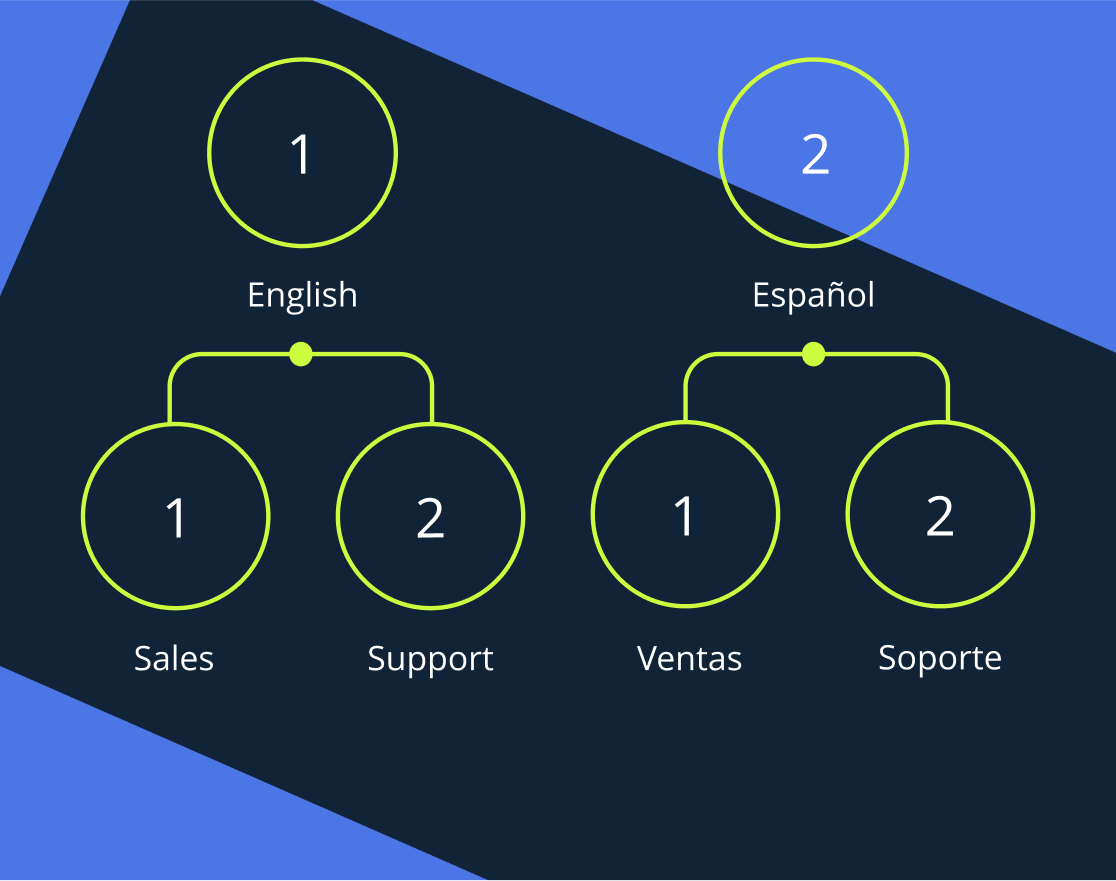
Design the call flow and set up effective call routing to ensure customers reach the right agent quickly, using simple IVR menus and skills-based matching. No one wants to get stuck in endless loops.
Best practices to use:
- Keep IVR menus short (3–4 options max)
- Always include an escape path for a live agent
- Define clear overflow rules for busy queues
- Set business hours prompts with after-hours routing
- Test flows weekly with real scenarios
Standardize scripts, escalation paths, and after-call work
Keep agents consistent without a robotic vibe: use scripts as flexible guidance, establish clear escalation paths to minimize transfers, and implement simple after-call routines to prevent CRM data from becoming a mess later.
Build a quality assurance framework for remote agents
A solid QA framework keeps remote agents consistent and growing. It’s all about coaching and quality, not just watching.
The QA loop starts simple: sample calls regularly, score them on a clear scorecard (e.g., empathy, accuracy), hold one-on-one coaching sessions, calibrate scores across the team for fairness, then analyze trends to spot bigger training needs or process tweaks.
6. Hire, onboard, and retain high-performing remote agents
Fancy tech won’t fix high agent turnover. It’s all about hiring the right people, solid onboarding, and building a culture that works for remote teams. Prioritize self-starters with strong communication skills and tech-savvy who can thrive without constant oversight.
What to look for when hiring virtual call center agents
Hiring great agents means spotting people who shine remotely. Key traits to look for:
- Self-discipline: Check via trial shifts or daily check-in consistency
- Clear communication: Test with roleplay scenarios or written summaries
- Tech comfort: Ask them to demo screen sharing or troubleshoot live
- Pressure handling: Simulate busy queues or upset customer roleplays
- Help-seeking: Test how they flag issues without waiting too long
Onboarding and training for long-term performance
Effective onboarding and training agents ensure long-term success by blending hands-on practice with ongoing support, so they hit the ground running and keep improving.
Cover the essentials first: a detailed examination of the platform, product knowledge, company policies, and soft skills such as empathy and objection handling. Then layer in continuous learning through a live knowledge base, weekly team calibrations, and regular coaching check-ins to reinforce what sticks.
Agent engagement, incentives, and retention strategies
Build a thriving remote culture to keep agents engaged and sticking around. Think about genuine recognition, straightforward expectations, fair schedules, and incentives that reward quality, not just churning through calls.
7. Launch your virtual call center using a pilot-first approach
Don’t launch your remote call center at once. Start with a small pilot to test everything in real conditions, then scale what works. This approach catches issues early and builds confidence.
Opening day isn’t the end goal; it’s just the starting line for ongoing tweaks and optimization based on live data and feedback.
Why a pilot launch reduces risk
A pilot launch is your low-risk way to test your call center solutions: limit it to a handful of agents, queues, hours, or products to iron out “wrinkles” before going big.
Why it pays off:
- Spot training gaps early
- Tests QA readiness on real calls
- Checks integration data flows seamlessly
Go-live checklist for virtual call center setup
Before going live with your call center, run through this practical checklist to ensure tech, people, and processes are in place. Go-live checklist:
- All agents have logins and tested lines
- IVR menus live and tested end-to-end
- CRM integrations are syncing data both ways
- Call recording and monitoring are activated
- Agent scripts and the knowledge base are accessible
- QA scorecards are ready with sample calls queued
- Backup internet/hotlines confirmed for agents
- Escalation paths tested with live roleplays
- Business hours messaging set (including after-hours)
- First-week schedules locked and shared
- Emergency shutdown procedure briefed
8. Operate and optimize the virtual call center with data
Running a virtual call center means treating data as your management system. It guides staffing decisions, improves coaching, and elevates customer experience every step of the way.
Optimize for real outcomes like resolutions and customer satisfaction, not just speed. This way, you can build something sustainable that grows with your business.
Core call center KPIs to track from day one
Track these core KPIs from day one to keep your virtual call center humming—data turns gut feelings into smart decisions on staffing, coaching, and customer happiness.
Efficiency metrics:
- AHT (average handle time): Flags training or tool issues. Aim for under 5 minutes to balance speed and quality.
- Wait time & abandonment rate: Guides queue tweaks—target 80% of calls answered within 20 seconds; abandonment under 5%.
- Occupancy/handle rate: Shows if agents are overloaded or idle. Shoot for 85% busy time.
Experience and quality metrics:
- FCR (first contact resolution): Measures one-and-done fixes. Target 75%+ to cut repeats.
- CSAT & NPS: Track customer sentiment. Aim for 85%+ CSAT to spot service gaps.
- QA score: Drives coaching focus. Keep above 85% through consistent reviews.
Using analytics to improve staffing, quality, and outcomes
Analytics turn your data into actionable steps to improve staffing, quality, and outcomes. Think of this as forecasting busy times or pinpointing where agents need help.
How to use it:
- Forecast peaks to staff up ahead of surges
- Spot low QA scores for targeted coaching
- Tweak routing based on wait time trends
- Cut repeat contacts by tracking FCR gaps
- Design for compliance, risk, and business continuity
Running a distributed virtual call center expands your risk range. More agents, devices, and locations mean more potential weak spots. Smart management keeps you agile without stifling operations.
Leaders should define clear rules upfront: consent for recording, data-handling protocols, access controls, and failover plans for outages. This practical approach builds trust and resilience from day one.
Regulatory and policy considerations for virtual call centers
Virtual call centers must navigate regulations head-on, especially with remote agents handling sensitive data across borders.
Key considerations:
- Meet privacy expectations (e.g., GDPR/CCPA data handling)
- Get explicit consent for call recording (“This call may be recorded”)
- Set data retention policies (e.g., 30–90 days)
- Enforce role-based access to customer info
- Follow outbound dialing rules (TCPA, region-specific hours)
Business continuity planning for remote operations
Virtual operations need business continuity plans to stay up and running, even when things go sideways, like internet outages or agent no-shows.
Key continuity steps:
- Outage playbooks with step-by-step recovery
- Automatic rerouting to backup queues or agents
- Backup staffing lists for quick call-ups
- Fallback to email or chat during voice disruptions
- Put rules in place to handle unexpected volume spikes
9. Design for compliance, risk, and business continuity
As operations become more distributed, the overall risk surface grows. Teams work across different locations, tools, and systems, which can make it harder to track how processes are handled and where potential vulnerabilities arise. To keep things running smoothly, leaders should define practical guidelines early on.
Regulatory and policy considerations for virtual call centers
Virtual call centers must navigate regulations head-on, especially with remote agents handling sensitive data across borders.
Key considerations:
- Meet privacy expectations (e.g., GDPR/CCPA data handling)
- Get explicit consent for call recording (“This call may be recorded”)
- Set data retention policies (e.g., 30–90 days)
- Enforce role-based access to customer info
- Follow outbound dialing rules (TCPA, region-specific hours)
Business continuity planning for remote operations
Virtual operations need business continuity plans to stay up and running, even when things go sideways, like internet outages or agent no-shows.
Key continuity steps:
- Outage playbooks with step-by-step recovery
- Automatic rerouting to backup queues or agents
- Backup staffing lists for quick call-ups
- Fallback to email or chat during voice disruptions
- Put rules in place to handle unexpected volume spikes
10. Scale the virtual contact center without losing quality
Scaling your modern call center is all about growing smart. Wait for stable KPIs, predictable staffing, mature QA processes, and clean CRM data before adding agents or volume. These signals show your foundation is solid and ready to handle more.
Don’t rush into new channels like chat or email too soon; premature expansion often tanks quality and overwhelms teams. Expand one piece at a time, monitoring metrics closely to keep performance steady.
When to expand channels, hours, and regions
Expand your virtual contact center’s channels, hours, or regions as customer expectations grow, and your business grows with them. Stable performance shows you can handle more without sacrificing quality.
Readiness triggers:
- CSAT consistently above 85% across a full month
- FCR holding steady at 75%+ with no dips
- Low abandonment rates (under 5%) even during peaks
- New agent training ramp-up under 2 weeks
When to upgrade platforms or add a BPO partner
Know when to upgrade your virtual contact center platform or bring in a BPO partner; it’s usually when growth hits your current setup’s limits, like clunky integrations or reporting blind spots.
However, be cautious. Switching platforms disrupts everything. Plan migrations carefully, including pilot testing and data backups, to avoid chaos.
Timeline expectations
While it’s possible to quickly create a virtual call center, building a stable, scalable operation requires a structured approach. Timelines vary by team size, tech stack, and complexity, but the table below offers typical ranges for SMB and mid-market SaaS teams.
Some steps can overlap with platform setup to speed things up, while others, such as testing and optimization, shouldn’t be rushed to avoid quality dips. Use this as a planning reference:
| Phase | Timeline range | Key outcomes |
|---|---|---|
| Platform setup & integrations | 2-4 weeks | Live system with CRM sync and basic dialer |
| Hiring & initial training | 3-6 weeks (parallel with setup) | 5-20 agents onboarded and ramped up |
| Testing & soft launch | 2-4 weeks | Stable KPIs, bugs ironed out |
| Full scale & optimization | 4-8 weeks | Predictable performance, ready for growth |
What can realistically be launched quickly
You can launch a basic virtual contact center quickly (within days) if you stick to simple, low-risk elements that prioritize stability over bells and whistles. This pilot approach lets SMBs test the waters without overcommitting and handle initial volume while they build toward maturity.
- Basic call routing and IVR for common inquiries
- Small agent group (3-5 people) on limited queues
- Core KPIs tracked with call recording enabled
What takes longer to mature
Maturity in a cloud contact center builds through repetition, data insights, and consistent coaching. There are no overnight hacks. Patience here protects the customer experience and keeps costs in check, aligning with the smart-scaling approach.
- Stable QA calibration across all agents
- Analytics-driven staffing and forecasting
- Omnichannel expansion into a full contact center
Factors that accelerate or slow down implementation
Rollout speed for virtual call center operations depends on structural factors. Diagnose these to set realistic expectations and adjust your business plan:
- Compliance and regulatory complexity (e.g., GDPR, HIPAA)
- Number of integrations required (CRM, billing, helpdesk)
- Hiring readiness or reliance on a BPO partner
- Clarity of ownership and decision-making
- Prior experience running call or contact centers
- Data cleanliness and agent training prep
Delays are often structural, not a sign of failure. Address them early to stay on track.
From first call to scale: Building a virtual call center that lasts
Building a business that lasts follows a proven loop: decide your virtual call center model, plan resources and KPIs, build the tech foundation, launch a pilot, operate with real data, optimize through coaching and QA, then scale smartly when signals align.
Don’t wait for perfection. Pick one next step today: define your operating model, nail down core KPIs, or kick off a small pilot. Steady action turns vision into a reliable operation.